Notes from the Practice · Spring in Full
There is a dish I have been working with for a long time.
It has always been a part of my menus, a marker of time and place. It's something that returns in slightly different forms depending on the season, the produce, and the direction of the menu. It is built around an onsen egg and broth, served with peak-seasonal greens. The idea has always been the same: to create something that can absorb the season without losing its identity. Most of the changes are subtle: a different garnish, a shift in texture, a shift in balance. These are the kinds of changes that sit quietly within the dish and do not call attention to themselves.
From time to time, however, the change is more significant. Not a refinement, but a shift in direction.
A Shift in the Broth
Until recently, the dish was built around a mushroom broth. It gave the plate a certain weight and depth. It felt warm, rounded, and comforting. It naturally belonged to the colder months, when cooking tends to settle and hold. It worked well, and it remained in place longer than most elements do. Over the past few weeks, it has been replaced with a lighter broth made with charred cucumber skins and kelp. The dish's structure remains, but the feeling has changed. It is less anchored now and more open. It is not necessarily simpler, but it sits lighter on the table.
Changes like this tend to happen gradually. I notice them first in the cooking itself, in the way certain flavours start to feel out of place, or in the way I reach for different ingredients without quite deciding to. The transition from a darker to a lighter broth is one of the clearest signs that the season has shifted, not in a dramatic sense, but in a way that becomes obvious once it has already happened. That shift extends beyond the dish itself. It affects how the menu is structured, how the courses relate to each other, and how the evening unfolds. It also affects the wine.
What was previously paired with red now naturally pairs with white wine, not because of a rule, but because the dish itself has changed its centre of gravity. The weight has lifted, and the expression has become lighter, fresher, and more uplifting. It is less comforting, less savoury, and more open. The wine follows.
This is where the work becomes more precise.
On Pairing
Wine pairing, for me, is not about finding a wine that matches a finished dish. It is about designing the dish so that it harmoniously interacts with the wine, allowing them to complement each other perfectly. The smallest elements often carry the most weight in this process.
A grilled mangalitza pork dish I have been serving recently illustrates this clearly. With the 2012 Saumur rouge 'Le Charpentrie' from Domaine du Collier, the plate was supported by a green chutney built on shishito peppers. The intention was not to mirror the wine, but to meet its structure. The herbal and pyrazine-influenced edge, the slight tension, and the way it sits just above the fruit. With a younger Bourgogne ‘Ladoix’ from Claire Naudin, the same dish took a different direction. I changed the chutney to one made from fermented plums. Softer, brighter, and more open. The meat remained the same, but the dish shifted its expression. It became lighter, not in weight, but in tone.
The same line of thinking appears throughout the menu. With a Styrian wine, or wines with heavy lees influence, I would lean into salt and crisp. Something like salt-fermented asparagus, where the structure tightens, and the wine is allowed to stretch. With Riesling or a ripe Chardonnay, that same element might be pickled instead, shifting the acidity and allowing the wine to settle more naturally into the dish. These are small decisions, but they are where the work happens. This way of working relies on a pantry that is constantly in motion.
The Pantry as Toolbox
Ferments, pickles, infused oils, and other preserved elements are not gimmicks or additions. They allow small adjustments that change how a dish behaves without rebuilding it entirely. The pantry is the toolbox from which we can build flavour.
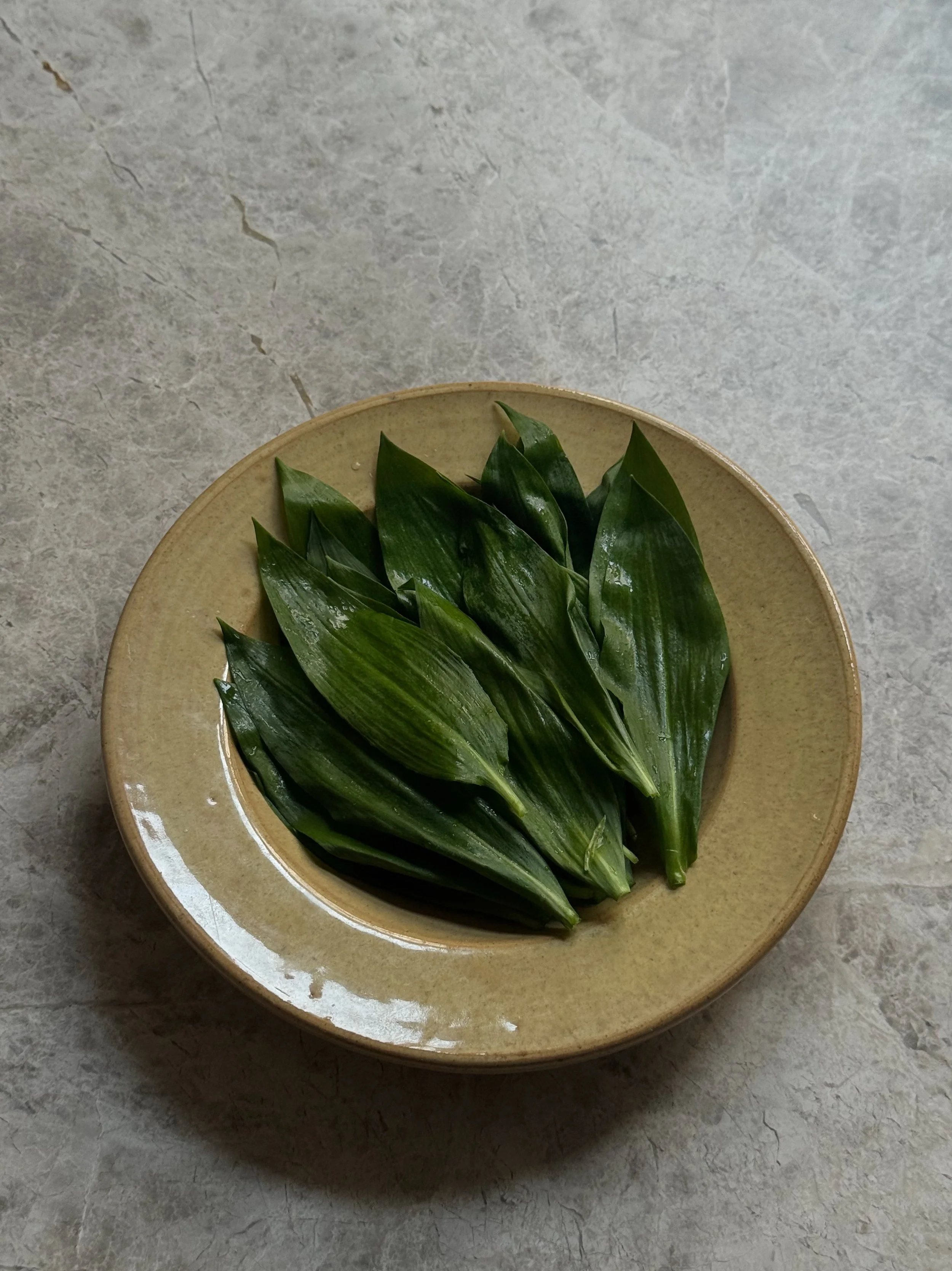
At the moment, that pantry is expanding again. Some of it comes from time already passed. Leek oil, both fresh and roasted, elderflower salt, and fermented asparagus from last year, still active and still capable of shaping a plate. Alongside this, new elements are arriving from the landscape. Magnolia, ramson, blackcurrant leaves, and onion cress. These are foraged now, used while they are at their peak, and preserved for the months ahead. Together, they form a continuous movement between seasons, where what was gathered before meets what is available now. These elements rarely stand alone. They work in the background, adjusting balance, extending flavours, or tightening structure. They are what keep cooking responsive, even when the dish's framework stays the same.
This kind of cooking is not built in isolation. It depends on timing, proximity to the table, and the ability to adjust as things come together. The dish, the wine, and the small elements around them are rarely final until the moment they are served. That is where the work settles. And it is also where the format begins to matter.
Formats of Work
Catering allows for scale. It makes it possible to gather larger groups, to create shared experiences, and to bring structure to events that require it. The work remains tailored. It is built through conversation, shaped by context, and executed with the same attention to detail. Private dining allows something further to happen.
It allows the meal to remain open for longer. It allows adjustments to happen closer to the moment, when the ingredients, the wine, and the atmosphere are fully present. The dinner becomes less about delivering a defined menu and more about shaping a sequence that belongs to that specific table. In that sense, it is closer to a restaurant, but without the need for repetition or standardisation. Each evening carries its own rhythm. The dishes shift slightly, the pairings are refined, and the experience is shaped with a level of precision that is almost impossible to achieve elsewhere. For the guest, this does not appear to be complex. It feels simple. The food moves naturally, the wine makes sense without explanation, and the evening unfolds without friction. What sits underneath, the adjustments, the pantry, the decisions, remains largely invisible.
Spring in Full
Spring has settled in fully now, and the cooking reflects that. Broths are lighter, greens are more assertive, and the dishes carry less weight without losing depth. The shift is not about doing less, but about doing things differently. Looking ahead, much of the coming period will be built around these dinners. Private dining, wine-focused evenings at home, and a growing number of summer gatherings and weddings where both formats play different roles.
The work remains the same; only the context changes. More from the kitchen, the cellar, and the practice soon
Marcus Palm,
Applied Notes
April 2026
The text was written in Danish and translated using AI- and grammar-assistants.