Notes from the Practice · When Summer Settles In
Last week has been unusually hot in Copenhagen. The sort of weather that changes not only what we want to eat, but how we cook altogether. The stove stays off a little longer. Vegetables are treated more gently to stay crisp and fresh. Lunch stretches into the afternoon, and dinner starts later than planned. Tomatoes have finally found their sweetness, peas are everywhere, herbs seem to grow faster than they can be picked, and every visit ends with a few more things than intended. There is a point each year when the season stops hinting at what is coming, and everything arrives at the same time. We seem to have reached it. As always, I find myself taking notes. Not just on ingredients, but on combinations, small adjustments, and the ways the same produce behaves from one week to the next. Summer has a habit of reminding me that cooking is rarely about adding more. More often, it is about noticing more.
Two months ago, I cooked the first wedding of the season, and since then, the spring and summer menus have settled into their own rhythm. They continue to change, as they always do, but the direction feels clearer now than a month ago. At the moment, I'm drawn to generous flavours and strong contrasts: tomatoes with sesame and koji, vegetables over charcoal, cold soups built around herbs, flowers, and infused- or green oils. These are the weeks I look forward to every year. The produce requires less technique from the cook but more of their attention. It feels like one of the strongest moments of the year to gather people around a table, whether that's a long lunch in the garden, an evening outdoors with friends, or a celebration that carries on well after sunset. Looking back over the last few months, I'm reminded that the practice is always moving. Menus evolve. Seasons shift. The notes become a little more useful.
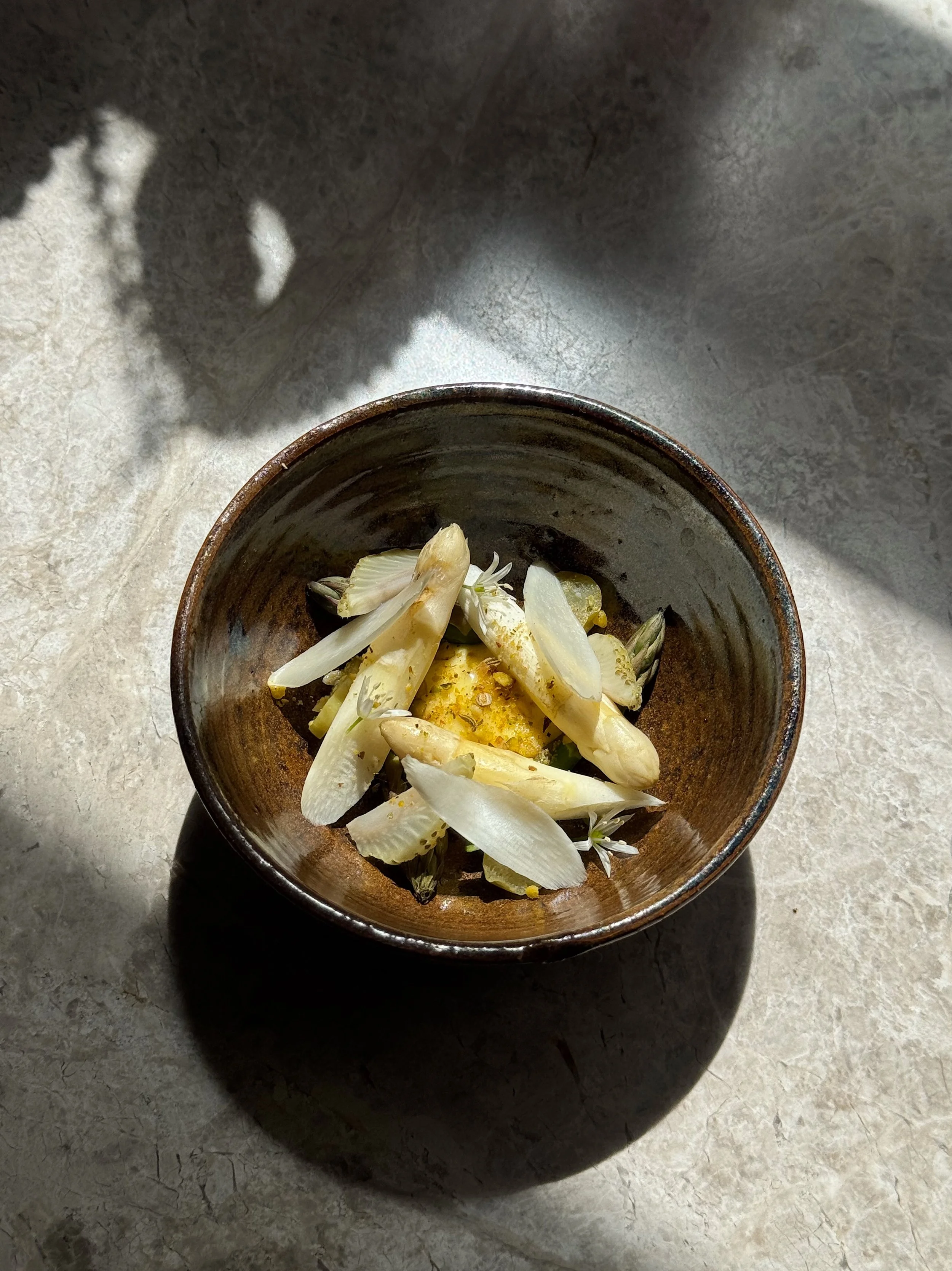
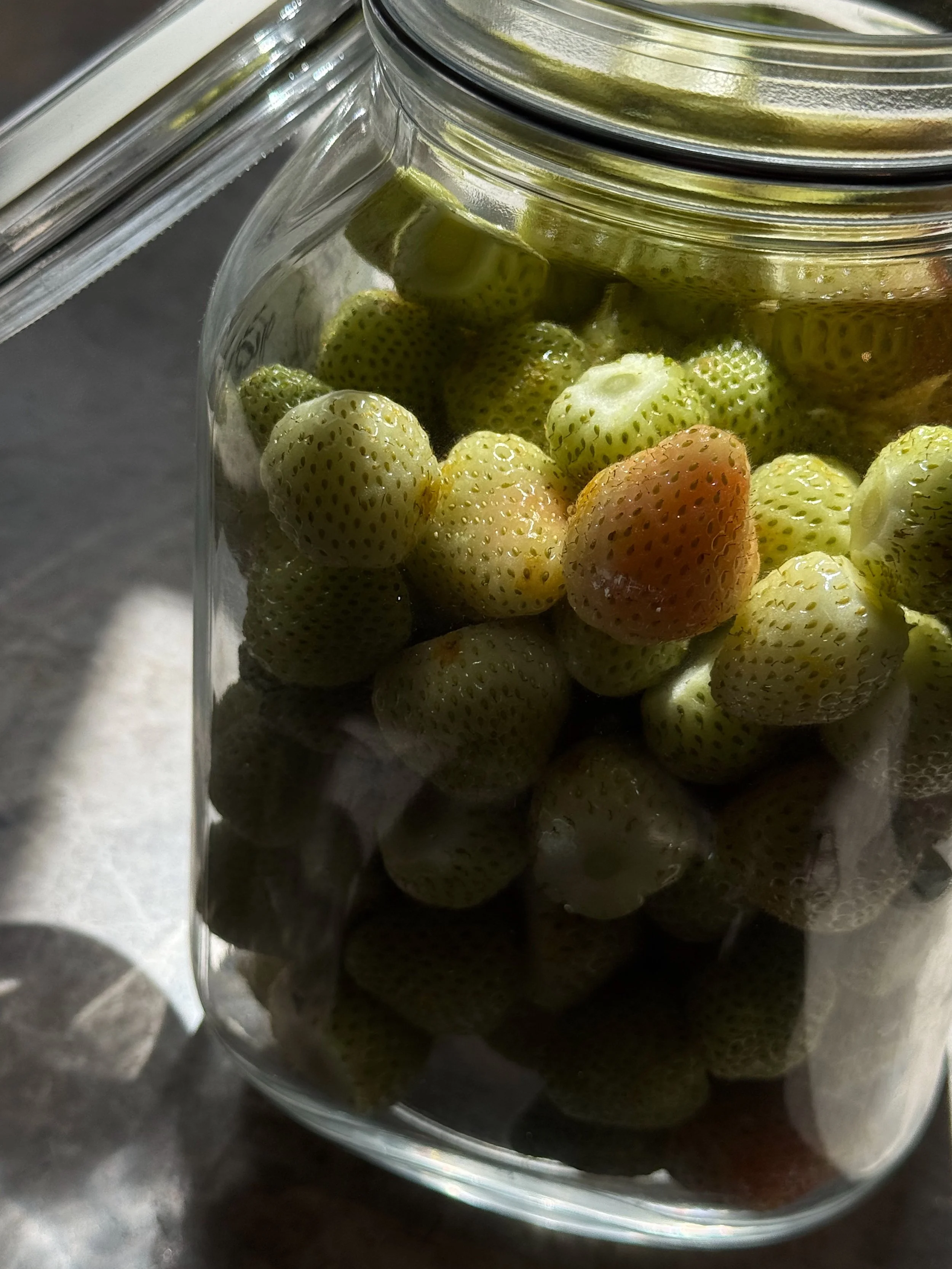
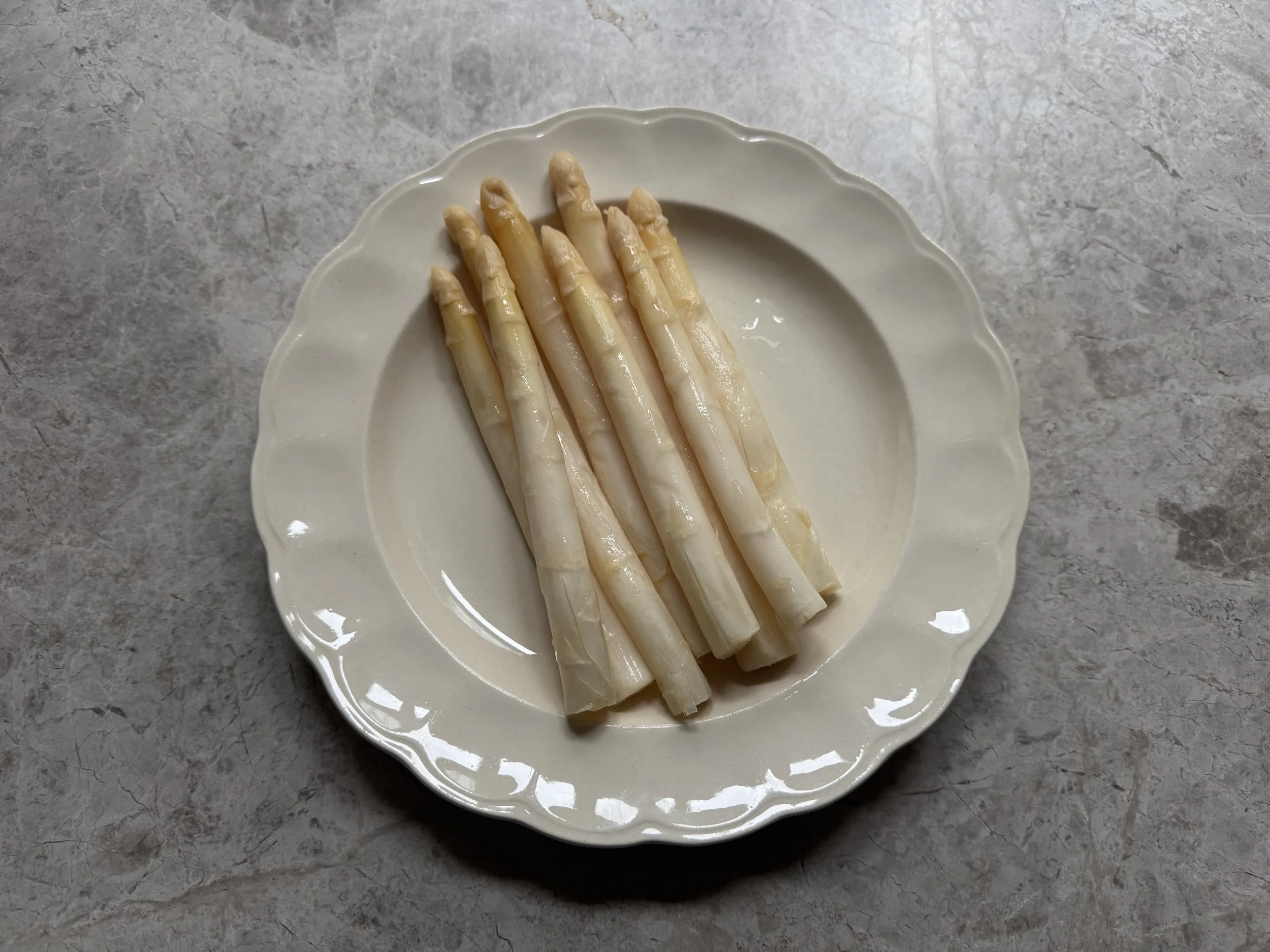
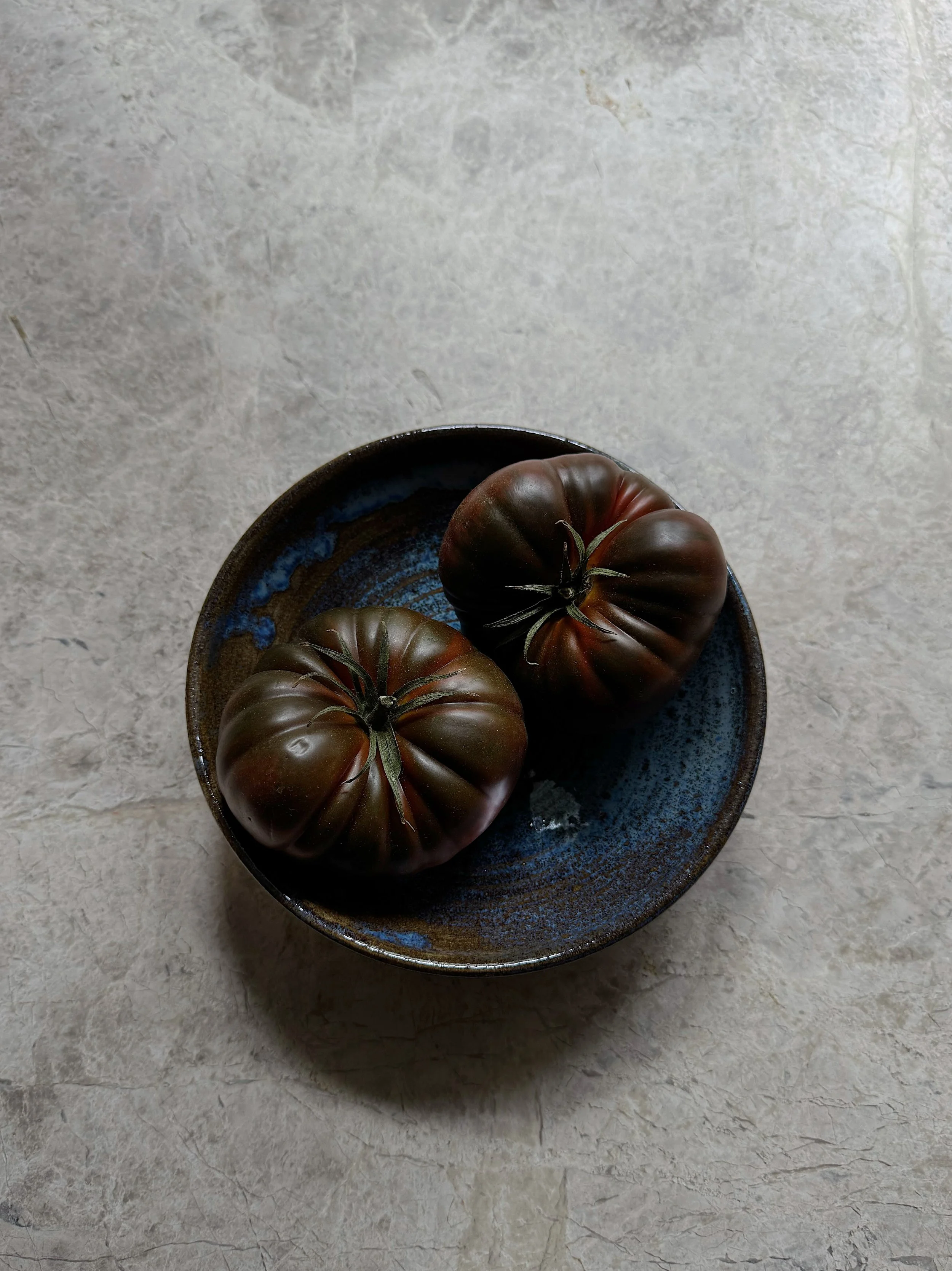
One note has stayed with me recently. Two dishes from the current menus share several ingredients: pickled strawberries, fermented white asparagus, and ramson flowers. Not because we are repeating ourselves, but because the same ingredients can serve different purposes depending on the menu. In the ten-course menu, white and green asparagus are paired with a Comté emulsion and pistachio dukkah. Here, the preserved elements bring freshness and lift to an otherwise rich and savoury dish. The wine often follows the same direction — a crisp but aromatic Savagnin from Jura or a sparkling rosé. In the six-course menu, tomatoes are dressed with sesame-and-koji vinaigrette, tomato dashi, and malt crumble. With fewer dishes available to tell the full story of a meal, the preserved elements take on a different role. They contribute texture, contrast, and complexity within the dish itself. Here, we often reach for a fresh, lightly chilled red, where the wine's fruit echoes the tomatoes while the malt provides enough depth to anchor it. The ingredients may be the same, but their purpose changes—one of the advantages of keeping notes.
The Wine Archive has continued to grow quietly alongside everything else. Rather than rushing to launch it, I've decided to let it develop as the cellar always has: patiently. Bottles continue to be sourced, tasted, stored, and followed over time before finding their way to the table. The ambition has never been to build a traditional wine shop, but rather a collection of bottles with provenance, maturity, and purpose. If you're looking for something specific, thinking about starting a cellar of your own, or simply curious about what is resting in the archive at the moment, I'd be delighted to hear from you. Access remains personal, and I suspect it will stay that way for quite some time.
Summer is largely spoken for now, and attention is already turning towards the months ahead. Autumn dinners, harvest gatherings, and, perhaps surprisingly, Christmas lunches are already finding their place on the calendar. If you're planning something later this year, now is a wonderful time to begin the conversation while there is still room to shape it properly. Whether it's a private dinner, a company gathering, a wedding, or simply a table you'd like to bring to life, I'd love to hear what you're thinking. Thank you for following along, reading these notes, and allowing Applied Notes to continue growing, one gathering at a time.
Marcus Palm,
Applied Notes
June 2026
The text was written in Danish and translated using AI and grammar assistants.
Notes from the Practice · Spring in Full
There is a dish I have been working with for a long time.
It has always been a part of my menus, a marker of time and place. It's something that returns in slightly different forms depending on the season, the produce, and the direction of the menu. It is built around an onsen egg and broth, served with peak-seasonal greens. The idea has always been the same: to create something that can absorb the season without losing its identity. Most of the changes are subtle: a different garnish, a shift in texture, a shift in balance. These are the kinds of changes that sit quietly within the dish and do not call attention to themselves.
From time to time, however, the change is more significant. Not a refinement, but a shift in direction.
A Shift in the Broth
Until recently, the dish was built around a mushroom broth. It gave the plate a certain weight and depth. It felt warm, rounded, and comforting. It naturally belonged to the colder months, when cooking tends to settle and hold. It worked well, and it remained in place longer than most elements do. Over the past few weeks, it has been replaced with a lighter broth made with charred cucumber skins and kelp. The dish's structure remains, but the feeling has changed. It is less anchored now and more open. It is not necessarily simpler, but it sits lighter on the table.
Changes like this tend to happen gradually. I notice them first in the cooking itself, in the way certain flavours start to feel out of place, or in the way I reach for different ingredients without quite deciding to. The transition from a darker to a lighter broth is one of the clearest signs that the season has shifted, not in a dramatic sense, but in a way that becomes obvious once it has already happened. That shift extends beyond the dish itself. It affects how the menu is structured, how the courses relate to each other, and how the evening unfolds. It also affects the wine.
What was previously paired with red now naturally pairs with white wine, not because of a rule, but because the dish itself has changed its centre of gravity. The weight has lifted, and the expression has become lighter, fresher, and more uplifting. It is less comforting, less savoury, and more open. The wine follows.
This is where the work becomes more precise.
On Pairing
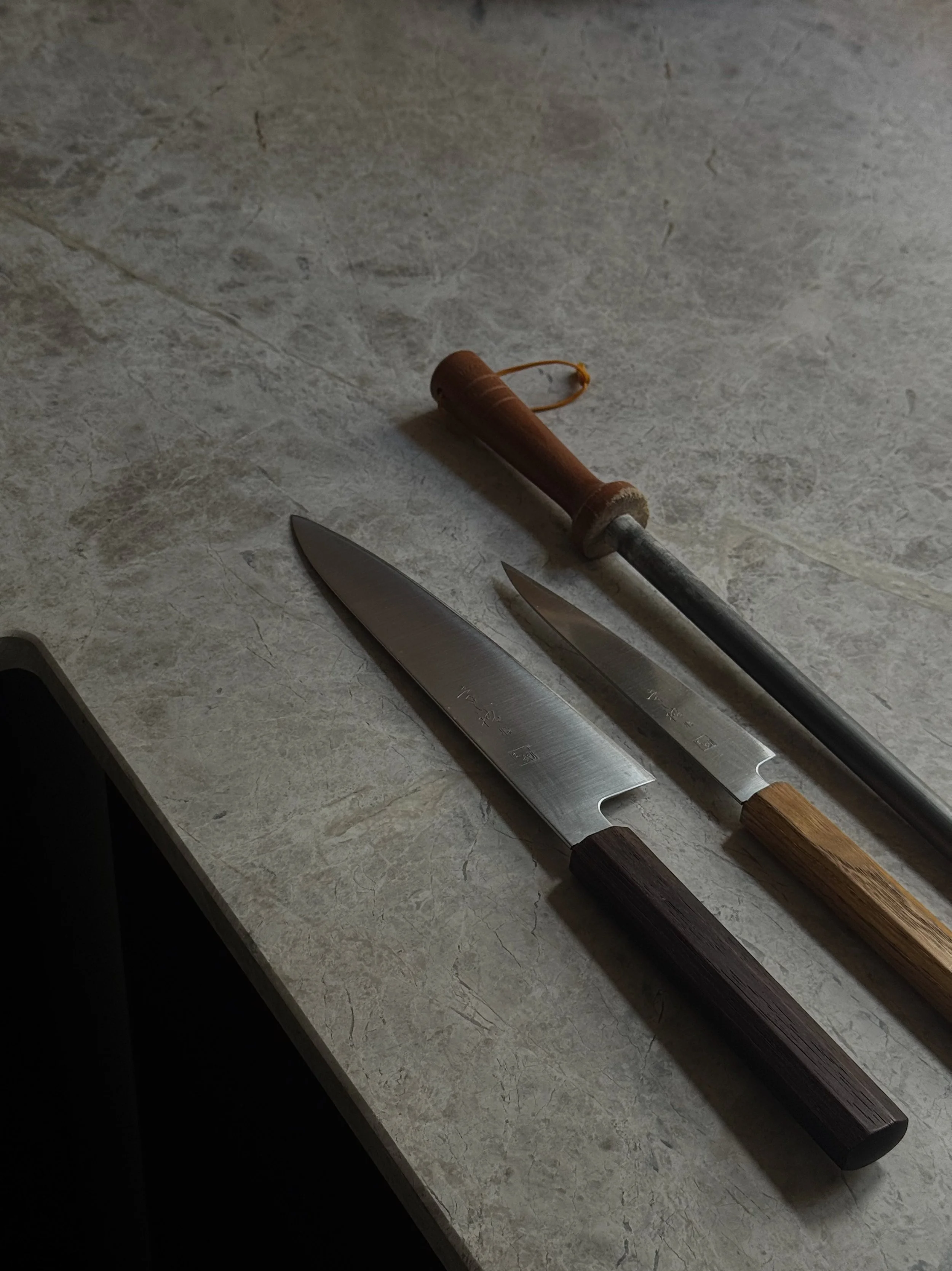
Wine pairing, for me, is not about finding a wine that matches a finished dish. It is about designing the dish so that it harmoniously interacts with the wine, allowing them to complement each other perfectly. The smallest elements often carry the most weight in this process.
A grilled mangalitza pork dish I have been serving recently illustrates this clearly. With the 2012 Saumur rouge 'Le Charpentrie' from Domaine du Collier, the plate was supported by a green chutney built on shishito peppers. The intention was not to mirror the wine, but to meet its structure. The herbal and pyrazine-influenced edge, the slight tension, and the way it sits just above the fruit. With a younger Bourgogne ‘Ladoix’ from Claire Naudin, the same dish took a different direction. I changed the chutney to one made from fermented plums. Softer, brighter, and more open. The meat remained the same, but the dish shifted its expression. It became lighter, not in weight, but in tone.
The same line of thinking appears throughout the menu. With a Styrian wine, or wines with heavy lees influence, I would lean into salt and crisp. Something like salt-fermented asparagus, where the structure tightens, and the wine is allowed to stretch. With Riesling or a ripe Chardonnay, that same element might be pickled instead, shifting the acidity and allowing the wine to settle more naturally into the dish. These are small decisions, but they are where the work happens. This way of working relies on a pantry that is constantly in motion.
The Pantry as Toolbox
Ferments, pickles, infused oils, and other preserved elements are not gimmicks or additions. They allow small adjustments that change how a dish behaves without rebuilding it entirely. The pantry is the toolbox from which we can build flavour.
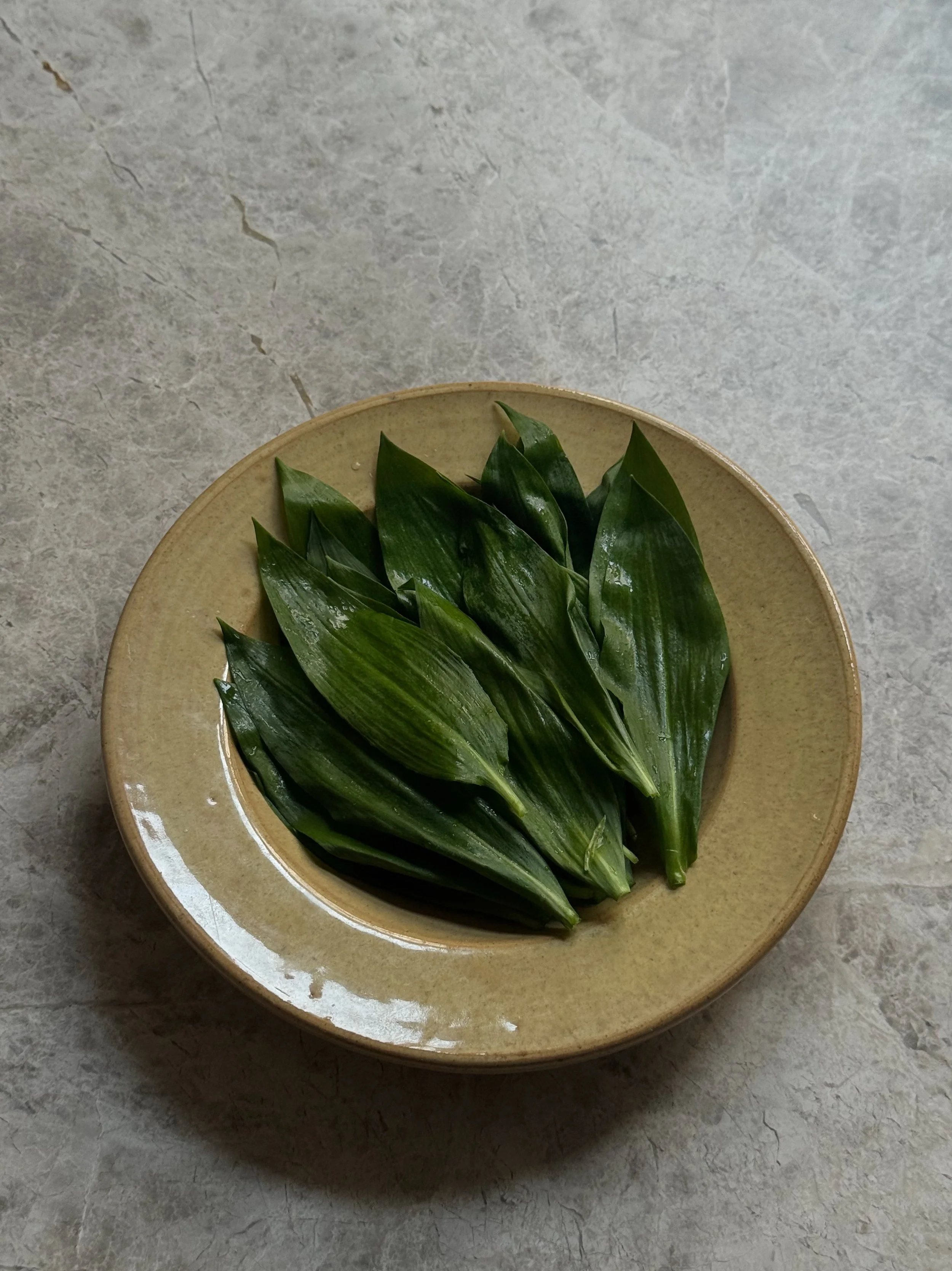
At the moment, that pantry is expanding again. Some of it comes from time already passed. Leek oil, both fresh and roasted, elderflower salt, and fermented asparagus from last year, still active and still capable of shaping a plate. Alongside this, new elements are arriving from the landscape. Magnolia, ramson, blackcurrant leaves, and onion cress. These are foraged now, used while they are at their peak, and preserved for the months ahead. Together, they form a continuous movement between seasons, where what was gathered before meets what is available now. These elements rarely stand alone. They work in the background, adjusting balance, extending flavours, or tightening structure. They are what keep cooking responsive, even when the dish's framework stays the same.
This kind of cooking is not built in isolation. It depends on timing, proximity to the table, and the ability to adjust as things come together. The dish, the wine, and the small elements around them are rarely final until the moment they are served. That is where the work settles. And it is also where the format begins to matter.
Formats of Work
Catering allows for scale. It makes it possible to gather larger groups, to create shared experiences, and to bring structure to events that require it. The work remains tailored. It is built through conversation, shaped by context, and executed with the same attention to detail. Private dining allows something further to happen.
It allows the meal to remain open for longer. It allows adjustments to happen closer to the moment, when the ingredients, the wine, and the atmosphere are fully present. The dinner becomes less about delivering a defined menu and more about shaping a sequence that belongs to that specific table. In that sense, it is closer to a restaurant, but without the need for repetition or standardisation. Each evening carries its own rhythm. The dishes shift slightly, the pairings are refined, and the experience is shaped with a level of precision that is almost impossible to achieve elsewhere. For the guest, this does not appear to be complex. It feels simple. The food moves naturally, the wine makes sense without explanation, and the evening unfolds without friction. What sits underneath, the adjustments, the pantry, the decisions, remains largely invisible.
Spring in Full
Spring has settled in fully now, and the cooking reflects that. Broths are lighter, greens are more assertive, and the dishes carry less weight without losing depth. The shift is not about doing less, but about doing things differently. Looking ahead, much of the coming period will be built around these dinners. Private dining, wine-focused evenings at home, and a growing number of summer gatherings and weddings where both formats play different roles.
The work remains the same; only the context changes. More from the kitchen, the cellar, and the practice soon
Marcus Palm,
Applied Notes
April 2026
The text was written in Danish and translated using AI- and grammar-assistants.
Notes from the Practice · Applied Notes
Early Spring
The sun finally reached the kitchen windows again this week. Not for long, but long enough to remind me that the season is beginning to shift. The last of the winter tomatoes disappeared a few days ago — the chocolate stripes that carried us through the darker months. They were good this year. Sweet, dense, and surprisingly expressive for something grown so far from summer.
Dinner recently was built around what remained in the pantry. Celeriac roasted slowly until it softened completely, mushrooms preserved from the autumn harvest, and a small jar of fermented asparagus from last year's spring. Cooking like this always feels slightly reflective — the kitchen leaning on the past season while quietly preparing for the next one. It's a moment I always enjoy. The kitchen feels undecided.
The Kitchen in Between
And that, in many ways, is where the name Applied Notes comes from. After more than a decade working with people, food, wine, and hospitality, the shelves — both literal and figurative — have filled with observations. Things learned from service, from growers, from long tastings and quiet mistakes, from seasons that behaved differently than expected. These are the notes. Applied Notes describes the act of using them — taking those fragments of experience and applying them carefully to a table, a menu, a wine pairing, or a gathering.
Instead of beginning with fixed concepts or predefined menus, the work begins with conversation. Every gathering has its own context: people, place, season, atmosphere. The role of Applied Notes is to gather the relevant knowledge — experience, research, sourcing, technique — and translate it into something that fits naturally within that setting. In other words: gather notes, apply notes, and eventually share notes.
On Notes
This approach also shapes the way I think about the business itself. Applied Notes is not meant to be a restaurant, nor a traditional catering company, and certainly not a pop-up concept that appears briefly and disappears again. I see it more as a partner — sometimes visible, sometimes quietly working behind the scenes. The work might involve designing a wedding menu, sourcing wines for a dinner, structuring a food and beverage programme, or simply helping a group of people host a gathering that feels thoughtful and generous. My name does not need to sit at the centre of the room. In many ways, I prefer the opposite: to work closely with clients and collaborators so that the result feels entirely their own.
Hospitality, after all, is rarely the work of a single person. It is something built collectively, through conversations, shared experiences, and a certain amount of trial and error. Applied Notes tries to embrace that process. Knowledge is gathered, tested in practice, and shared again through dinners, workshops, consulting projects, or simply through conversations around the table.
In Practice
Since January this year, the practice has been quietly open, focusing primarily on private dining and tailored gatherings. Cooking and hosting will always remain the core of what we do. Running a practice — cooking, serving, pairing wine, welcoming guests — keeps the work grounded. It ensures that ideas remain connected to real kitchens and real tables, rather than drifting into abstraction. At the moment, the kitchen still leans toward winter cooking. Celeriac, roots, broths that take their time. But there are already small changes. Herbs are appearing again. The cooking becomes slightly lighter without anyone really deciding to make it so. Soon the asparagus will arrive again. Every year, it feels like a small turning point in the kitchen — the moment when spring stops rehearsing and actually begins. Until then, we cook with what remains, and with a certain amount of anticipation.
Wine follows a similar rhythm. Pairings are never built as formulas, but as responses to the ingredients and the occasion. Sometimes a dinner calls for something bright and immediate in the glass, something that lifts both the food and the conversation. Other circumstances ask for something quieter — a wine that unfolds slowly over the course of the meal. It is a privilege to work with growers and producers whose bottles carry such clarity of place and intention.
The Wine Archive grows from that same way of thinking. It is a structured and evolving cellar, built slowly and deliberately over time. Bottles are sourced directly, stored correctly, and followed with patience — not simply bought and resold. We acquire wines we believe in and hold them until they are ready to drink, so what leaves the cellar carries context, maturity, and intention. It sits somewhere between a private cellar, a sourcing practice, and a small membership-based shop. Some bottles will be opened at dinners and tastings, others allocated quietly to clients, and others sourced specifically on request. A more structured membership and allocation model is taking shape. Until then, access is handled personally, by conversation.
Looking Ahead
Looking ahead, the coming months are beginning to take shape. Conversations around summer gatherings have begun, and several weddings and larger celebrations are already in the works for the coming seasons. Private dining remains at the heart of the practice — intimate dinners at home, wine-focused evenings around the table, or small celebrations that benefit from a little extra attention. It is a privilege to be invited into these moments, and I am deeply grateful for it.
For now, this first note marks the beginning. More thoughts from the kitchen, the cellar, and the practice will follow soon.
Marcus Palm,
Applied Notes
March 2026
The text was written in Danish and translated using AI- and grammar-assistants.